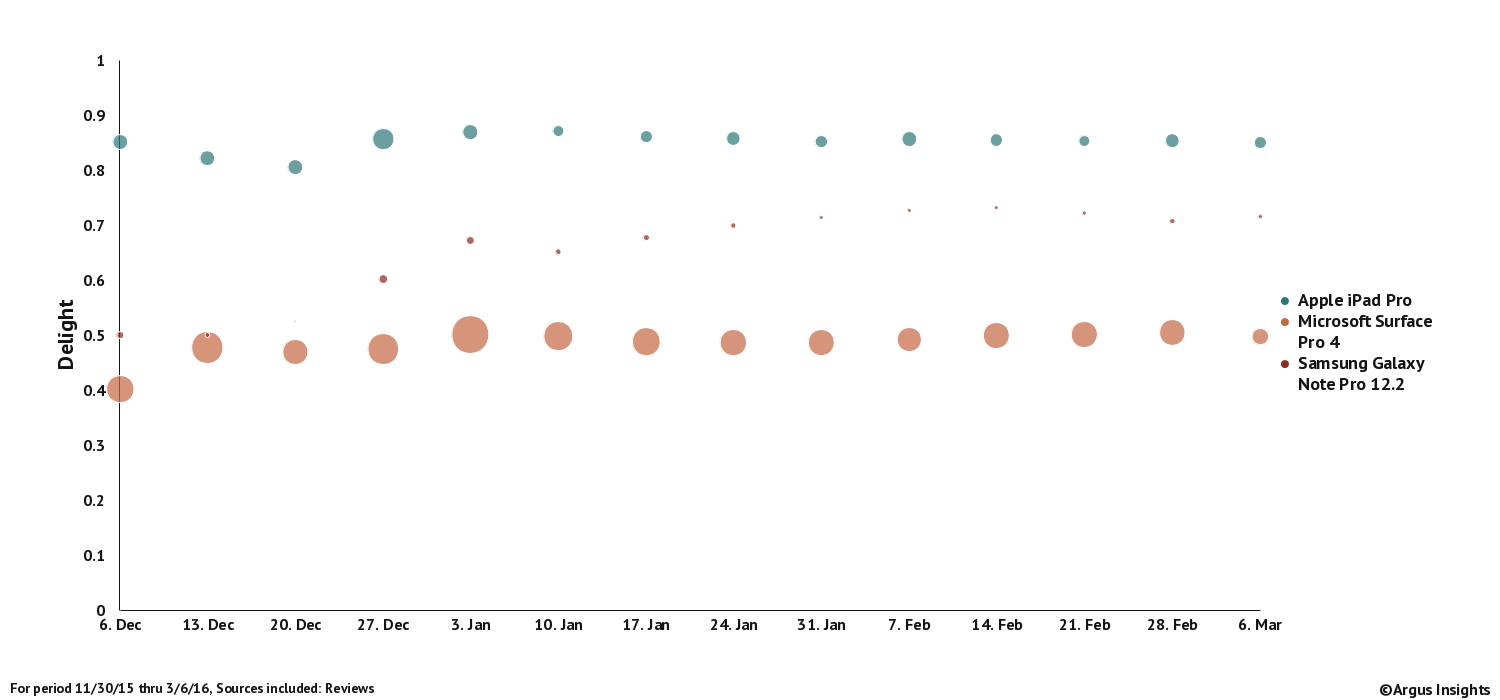
Tablets are a wonderful device for getting work done while you are on the go, but the market has gotten so cluttered it is difficult to identify the best devices. Major manufacturers Apple, Microsoft, and Samsung all offer several different tablets with a variety of sizes and functions. Among the high end models from these tech giants, Apple’s iPad Pro is the most well liked, while Microsoft’s Surface Pro 4 receives the most consumer feedback but is the least liked of the bunch (the size of the bubbles in the chart below represents consumer review volume by week).
Chart of the Day: Need to get work done on a tablet? Consumers prefer the iPad Pro to the Microsoft Surface Pro 4
For weekly insights into the Smartphone, Smart Home, Wearables, and SDN & NFV markets, subscribe to our free weekly newsletters.
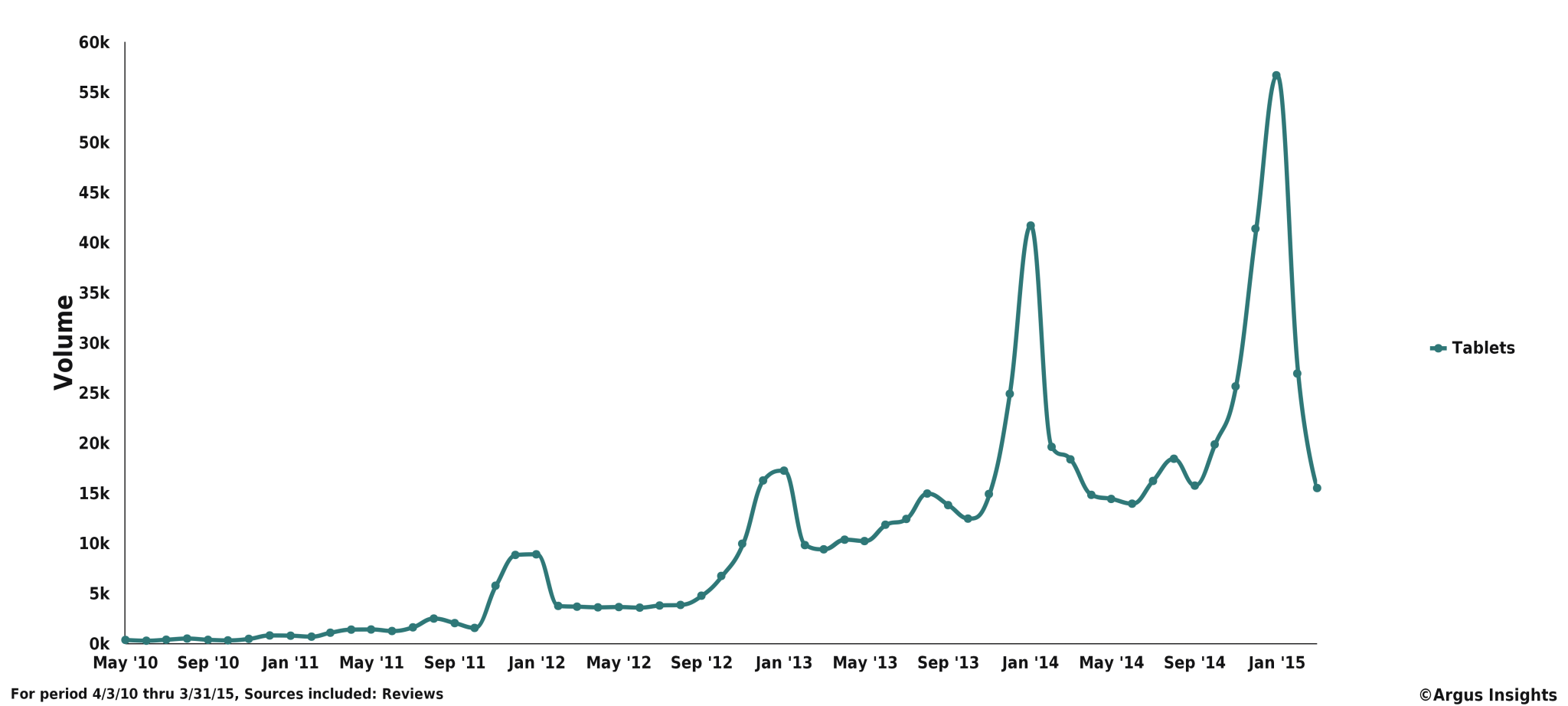
Apple is in the business of revolutionizing markets. They create products that transform the way humans interact with technology, and that focus on the experience is what keeps them ahead in hearts and minds of countless electronics consumers. The iPod put 10,000 songs in our pockets, the iPhone introduced easy to use internet to the palm of our hands, and 5 years ago today, the iPad transformed the bulky tablet into a sleek, hand held entertainment and productivity hub. The tablet market exploded after Apple introduced the iPad to the world, but in recent years, sales have been slowing as smartphones are growing.
Apple sparked consumer interest in tablets with the introduction of the iPad
According to IDC, in the year after the launch of the iPad, Apple controlled 77 percent of the tablet market. However, as the market developed, Apple lost much of that mindshare to the likes of Amazon and Samsung, as these companies rode the wave of the iPad to optimize their own tablets. Today, Apple and others are struggling to sell tablets since smartphones are encroaching on the established use cases. Brands are now pushing tablets into the worlds of education and business, hoping to fill a technological void too big for a handheld device.
After revolutionizing the market in 2010, Apple has lost majority mindshare to Amazon
Although Apple is no longer leading the tablet market, they legitimized it with the introduction of the iPad in 2010. As they are vying to sell the umpteenth version of the iPad to school children and busy business people, they are also scurrying to revolutionize the wearables industry with the Apple Watch. The Apple Watch, however, is not poised to achieve the same greatness as the iPad. Past Apple superstars offered dramatic improvements to the user experience, but the Apple Watch is dropping a sensor filled smartwatch with a fashionable flair in to a sea of the same. Apple has yet to transform the wearables experience, and if they do not rewrite the rules of smartwatch manufacturing as they did with the MP3 player, mobile phone, and tablet, the Apple Watch will not improve their legacy of greatness.
Pre order our Apple Watch Launch Report to gauge its success and impact on the wearables market before sales are even reported. Available Monday, May 4th (just 3 days after launch).
Gone are the days of fighting over the television remote. Now, you use your giant smartphone to keep up on emails while watching House of Cards on your tablet as your kids enjoy their own cartoons on Netflix or entertain themselves playing Temple Run on their own devices. The use of personal electronics for content consumption has taken off, and users are migrating away from large, communal televisions and small smartphones toward the happy middle ground of phablets and tablets to entertain themselves.[1]
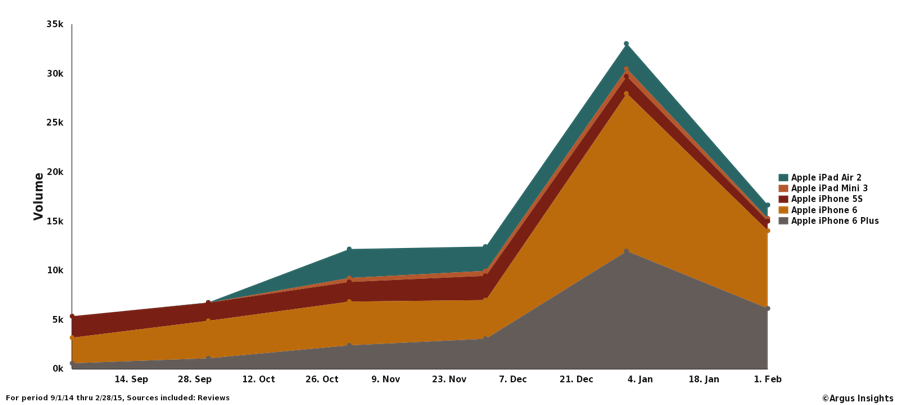
Large screens brought large mindshare for Apple smartphones and tablets
In the midst of this large screen, small device trend, Apple has stalled the production of their new iPad to produce a larger device. Their iPad sales have been suffering, and they plan to target the cooperate market with these larger devices. A 12.9 inch screen and alleged plans to add USB ports and an optional attachable mouse and/or keyboard are blurring the lines between tablet and laptop. A similar phenomenon occurred when Apple released the larger iPhone 6 and 6 Plus handsets. Sales of the big smartphones have “been cannibalizing…iPad sales.” Apple CEO, Tim Cook, has been quoted to say that this is a good problem to have, as the company is merely making competition for itself. [2]
Small & large Apple tablets see more consumer feedback than Samsung’s Pro Tab line
Apple smartphones are competing with Apple tablets, while those same tablets have the potential to compete with Apple laptops, but consumers are far more interested in Apple tablets than those made by Samsung. Big or small, Apple’s devices see more consumer reviews.
Although they are outshining the competition, Apple must compete with themselves as growing screen sizes shift usage expectations. With the introduction of their larger, more cooperate focused tablets, Apple is beginning a targeted, niche enterprise in which iPad users can easily crunch numbers on a spreadsheet and compose documents, or watch Netflix and play games.
Argus Insights will continue to track consumer engagement in the tablet and smartphone markets. Check back to hear more about the progression of user experience as it pertains to screen size and to follow the launch of new products. We monitor various consumer electronics markets as well as B2B infrastructure conversation. Please contact us with any questions or business inquiries.
Interested in who & what won mindshare during Mobile World Congress? Request a free copy of our Post MWC Report.
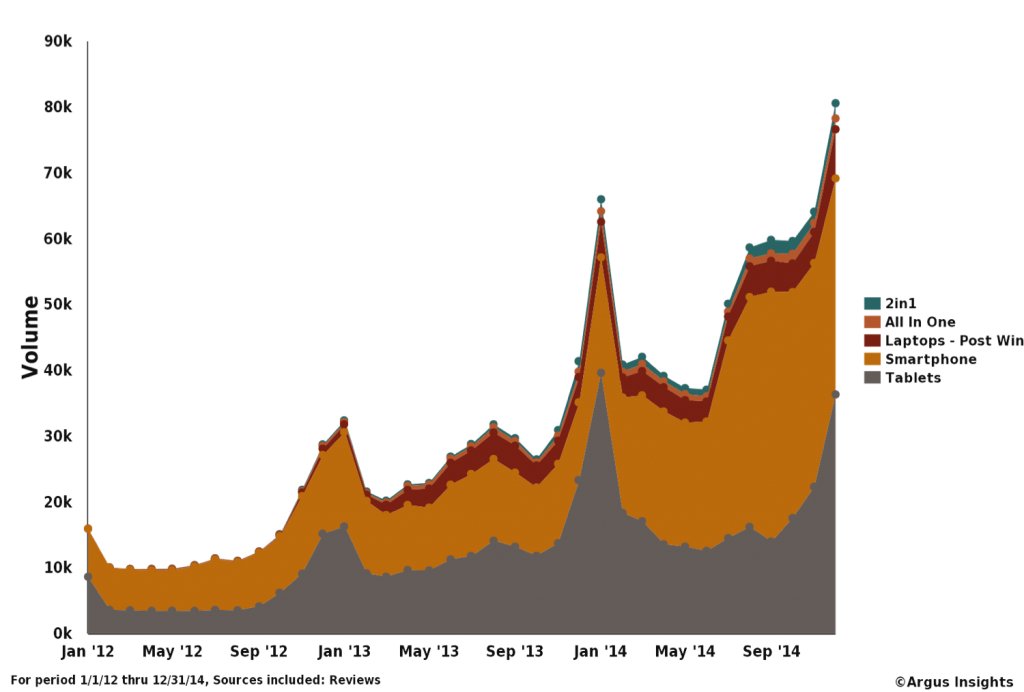
CNET reported that Intel announced “its first full year of revenue growth since 2011,” and it was “driven in part by rebounding PC revenue.” Over the past couple years, innovation and rapid improvement of smartphones and tablets has driven consumers away from tired old PCs and laptops. Today, we are seeing a “rise of hybrid tablet-laptop computers, dubbed “2-in-1” devices,” that are pulling people back into the PC market. This rise in the 2 in 1 market is evident when analyzing the volume of consumer reviews across these various categories. Tablets and Smartphones continue to hold the majority of mindshare, but just as everyone went ‘back to school’ this year, 2 in 1 devices saw increased attention.
2 in 1 & All-in-One Devices are Gaining Attention from Consumers
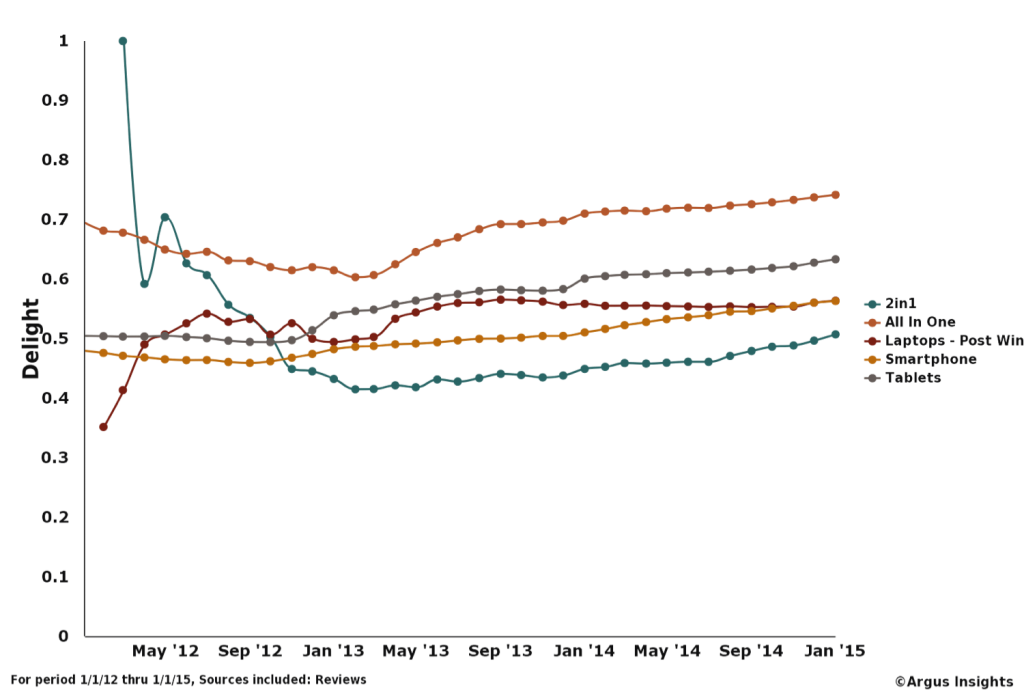
As more consumers begin to buy 2 in 1 devices, however, they are not enjoying them as much as more traditional technology. 2 in 1 delight scores have been rising steadily since 2013, but they remain the lowest of the common consumer computing devices. Delight across all devices, except for laptops, is improving as consumers are finding satisfaction with something else, whether it is an All in One, 2 in 1, Tablet, or Smartphone.
Delight for Laptops Declines as all Other Devices Gain Favor
While CNET reported on Intel’s growth as a result of better PC sales, they are poised to make waves in several other markets as well. Intel stole the (Consumer Electronics) Show in Las Vegas this year, as their involvement and innovation in several categories, including wearables, automotive, IoT, and drones won them the most mindshare of all the component suppliers and brands present at the show. While Intel saw growth in the standard laptop market as devices were adapted to consumer needs, they introduced innovative technology like a responsive spider dress, a button sized super computer, and much more, to intrigue consumers at CES.
We would love to tell you more about why Intel won consumer interest at at CES, and which other brands and products you should pay attention to in 2015. If you would like a free copy of our comprehensive CES Report, please indicate your interest and we will send it over.
[themify_button style=”large orange embossed” link=”https://argusinsights.com/ces2015/” target=”_blank” ]Sign Up for Free CES Report[/themify_button]
Just a quick note from Argus Insights to give some hints as to what we have cooking for 2015. 2014 has been a year of expansion and growth for Argus Insights. Not only has our coverage of Consumer Products expanded to include Wearables, Appliances, and Internet of Things devices, but we are also pulling consumer data globally from Chinese smartphone users, and Indian and German Consumer Electronic consumers.
Our ability to beat Wall Street Analysts on where consumer markets are headed continues to be validated with accurate predictions on Apple, Best Buy and other brands during 2014. We have also expanded our analysis of consumer behavior in social media to include B2B categories such as Software Defined Networks, Embedded Vision, Network Function Virtualization, Internet of Things, Cloud Computing and more. Please do not hesitate to contact us with any questions.