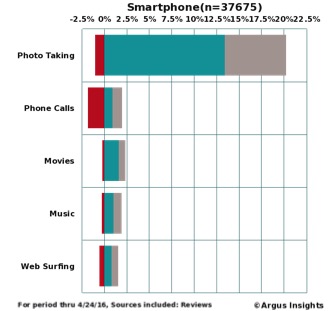
Technology has advanced at an incredible pace since the initial introduction of smartphones. With internet access plus a slew of features now available on nearly every device, smartphones can now be used to replace a camera, MP3 player, and even to preform functions previously reserved for laptop and desktop computers. According to analysis of consumer smartphone reviews from March and April 2016, photo taking is the most discussed smartphone usage among consumers. Not only do users mentions taking photos more than making calls, but they are also far more pleased using their phone as a camera than as an actual phone.
Chart of the Day: Smartphones are used as ‘phones’ second, and cameras first
Let us know if you have any questions about how Smartphones fit into the Internet of Things, we will answer them in our upcoming IoT Webinar!
You can also get insights into the minds of smartphone consumers on a regular basis with our Free Newsletters.
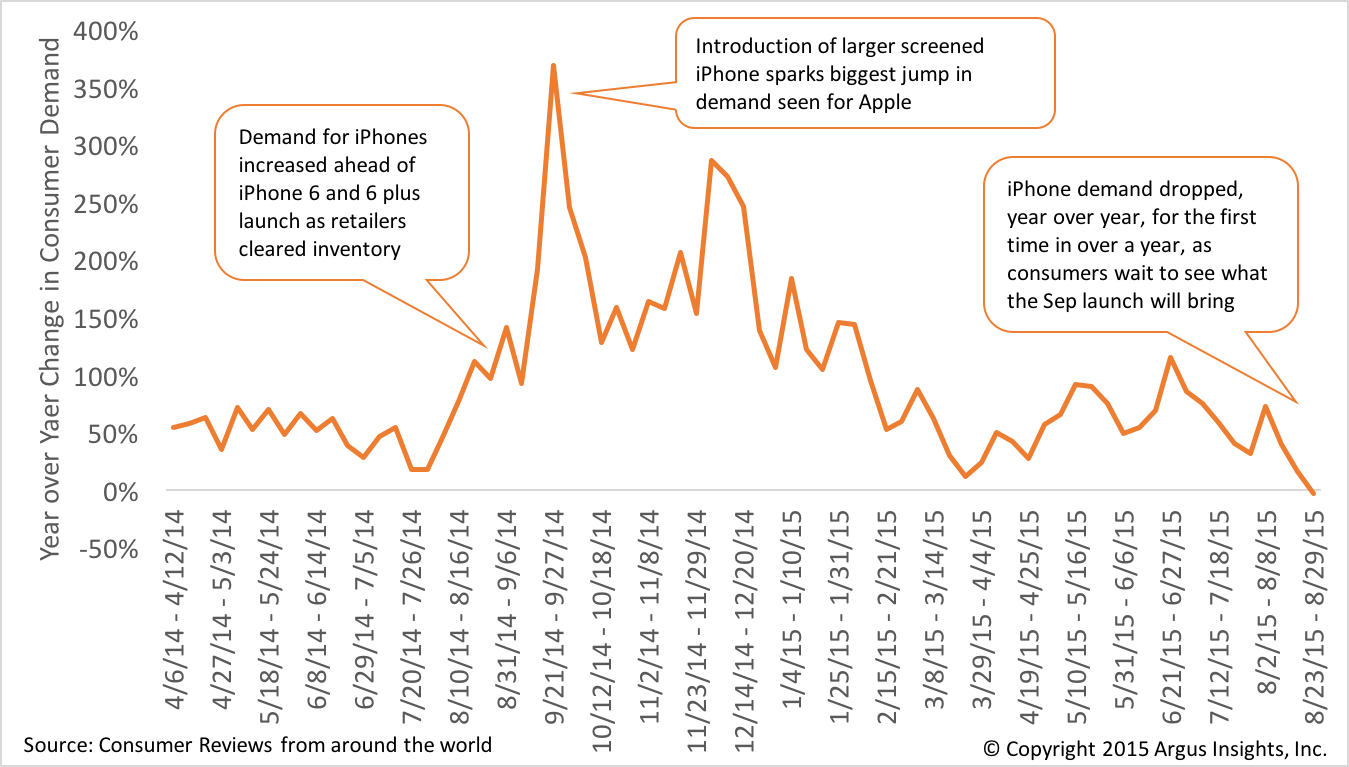
Apple is set to release its latest iteration of the iPhone on September 9th, along with a few other ‘surprises.’ This release is scheduled amid saturation in the market, leaving us with the question: how much demand is still latent in the market for the 6S…or whatever designation Tim rolls out on the stage?
We’ve already seen Smartphone demand slack tremendously this year, impacting Samsung and the entire China market as consumers hold on to ‘good enough’ handsets. So, will this fall be Apple’s last bumper crop of iPhones? Or has the market fallen too far from their tree of Heart’s Delights? At Argus Insights, our reading of consumers matches public comments by CEO John Feland earlier this year, that Apple has one good cycle left in them, barring any earth shattering innovations.
iPhone Demand Slowing ahead of Sept 2015 launch, suggesting consumers waiting to upgrade to the new handsets this fall
iPhone 5S and 5C users were pulled into the upgrade cycle two years ago, and are now hungry for the bigger, bolder iPhone rumored to be launched on September 9th. Additionally, Android users who were still locked in during the iPhone 6 and 6 Plus launch last year, and those disappointed by the recent ‘Pengazi‘ issues with the Galaxy Note 5, are also likely converts to whatever handset Apple chooses to share with the world. As such, this fall and coming holiday season will be very big for Apple. Not as big as last year, but large when compared to the falling fortunes of most of their big competitors.
Unlike Cher, this upcoming round of iPhones is likely to be the iPhone’s Farewell tour. Market demand of future handsets will not be as high because the innovation pipeline has apparently run out of good (compelling enough for consumers to upgrade) ideas. iPhone sales are unlikely to hit the same peaks at next year’s upgrade cycle as the level of smartphone saturation tips to replacement over new users.
Argus Insights is founded on the fact that mindshare anticipates demand. Through curated analysis of global consumer reviews and social media conversations, the firm provides comprehensive visibility at market, product, and attribute levels to determine what is delighting and disappointing the market. Customers take action on our insights to deliver better products, more impactful launches, create forecasts, perform competitive analysis, and track events and analyst relations. Take action today, schedule a free market fit assessment.
For more information about falling smartphone demand, download our free Q2 2015 Demand Report
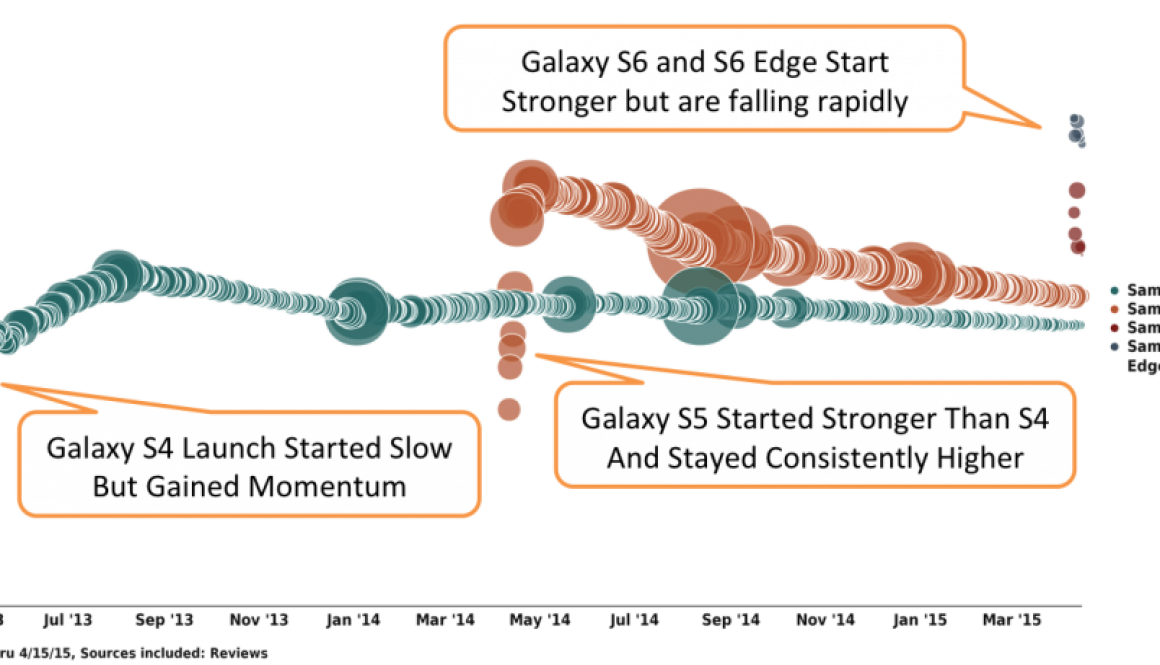
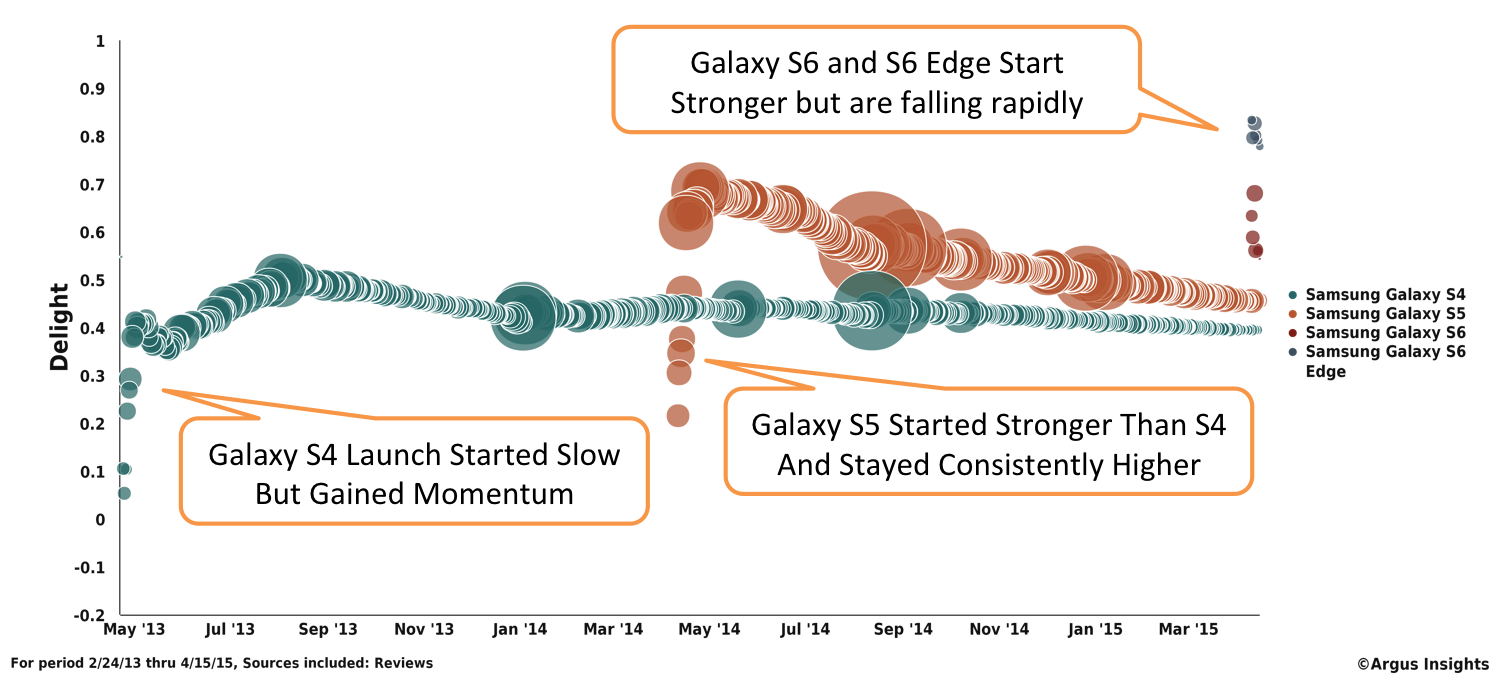
April 10th was a big day for the consumer electronics market. The Apple Watch was available for preorder in the midst of much speculation of its success or failure to turn the heads of millions of wearables customers. Oh yes, and Samsung’s newest flagship phones, the Galaxy S6 and the curvaceous Galaxy S6 Edge, were available for sale at retailers and carriers. This made little noise during the past seven days in the consumer demand data we track here at Argus Insights. In fact, both of these phones are seeing less demand than any flagship launch Samsung has had in the past two years. Both the slow to sell S4 and the OMG this is awesome S5 faired better with consumers than the Galaxy S6 and S6 Edge have so far.
Galaxy S4 and S5 both started with grumpy consumers but went on to gain in both delight and demand with picky smartphone consumers. S6 and S6 Edge seem to be taking the opposite path.
In fact, the total demand for both handsets is lower than either the S5 or the S4. What is even more disturbing is that every new customer is more disappointed with the handset than the last. Though Samsung and others are forecasting 70 million units sold, we are seeing much slower demand unfold for Samsung as they struggle against Android powered upstarts from China like Xiaomi and the increasing global dominance of Apple. Samsung needed a win with the S6. Our analysis is showing the S5, iPhone 6 and 6 plus all three received boosts in demand coincident with the Samsung Galaxy S6 launch.
New Galaxy S6 and S6 Edge launch to fewer, happier users but are rapidly losing momentum with smartphone customers.
To add insult to injury, US consumers are receiving aggressive promotions from at least Best Buy and Verizon offering $200 giftcards and early upgrade subsidies respectfully. The handsets have only been in stores for seven days, and already retailers are working hard to move them out of inventory; Leaving us with the question, are the latest Galaxy handsets hot phones or hot potatoes? Our analysis of the launch so far points to these devices being hot potatoes that retailers bought too many of from Samsung, leaving them desperate to move inventory.
If you want to get our monthly Heartbeat Report on what is driving the Smartphone Market, a bargain at just $600o for 12 monthly reports, you can sign up here.While most other vendors report on the market at least a month behind, Argus Insights is able to provide a detailed snapshot within days of the prior month’s end, the fastest in the industry! Clients of our full services get real time access to both insights and services. Let us know how we can help here!
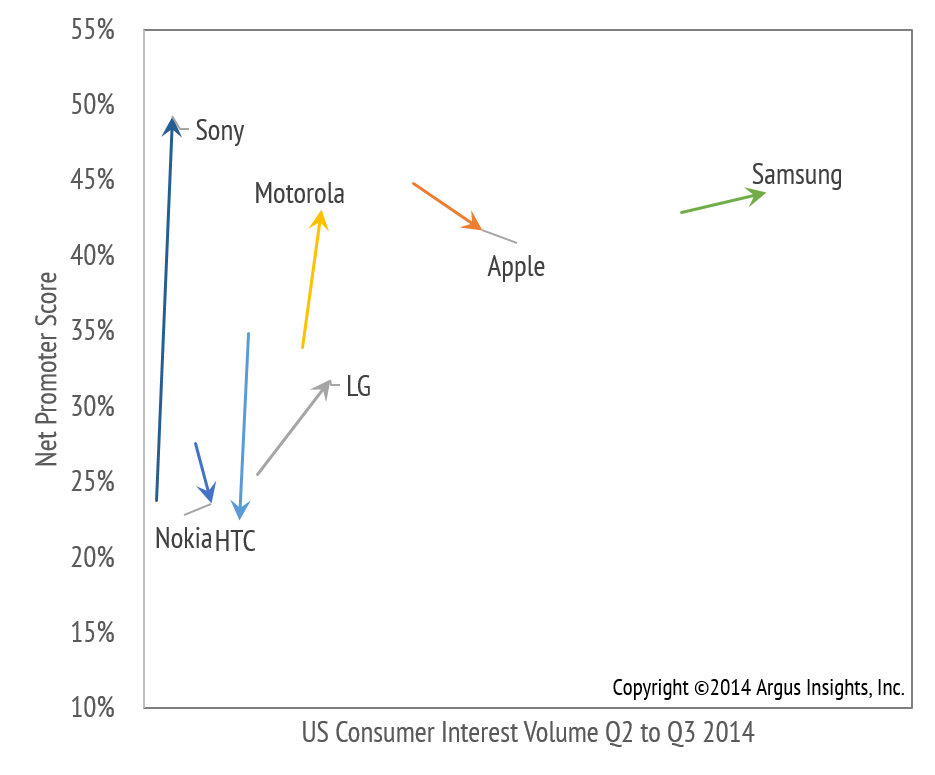
Takashi Mochizuki recently published an article that Sony has once again cut their sales targets for mobile devices, which was a prudent move for Sony given the global competition they face. But hold in there, they aren’t dead yet. Our analysis shows that Sony has actually gained Mindshare in Q3 2014, just not at a rate to move the needle on quarterly expectations. Sony still lags behind all other handset brands in terms of buzz volume, but saw a spike in Net Promoter Score. This means that while their products are not widely discussed, the few consumers reviewing them are delighted. Motorola experienced a similar resurgence thanks to the Moto G and Moto X. The increasing delight surrounding Sony and Motorola show that consumers do not need the prestige that comes with an iPhone of Galaxy smartphone; in fact, they are enjoying less popular handsets more.
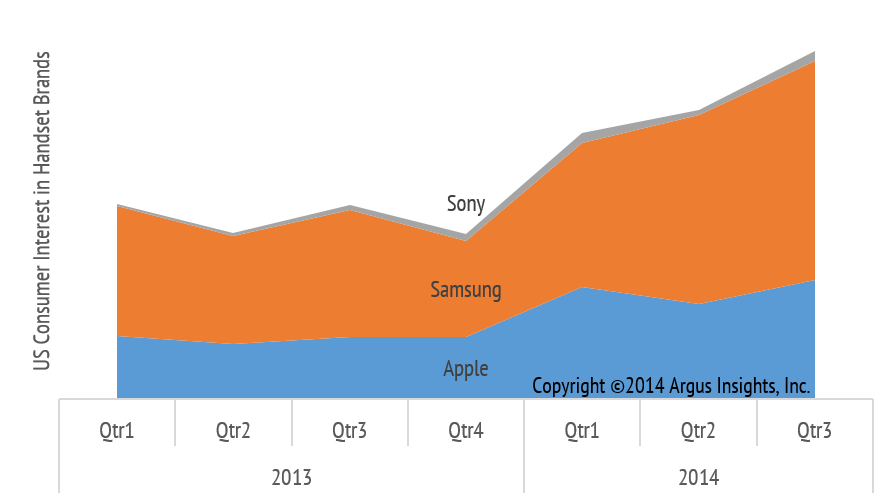
Pitting Sony against smartphone giants Apple and Samsung in terms of consumer interest paints a grim picture. However, if we measure Sony against themselves, it is clear that their mindshare is growing. The thin grey line above the giant block that is Samsung represents consumer interest by way of review volume for Sony Smartphones over the past 2 years. This line is slowly but surely growing thicker as Sony is commanding more interest.
While Sony is clearly not as popular as Apple and Samsung, they are seeing a different type of growth. People cannot stop talking about iPhones and Galaxy phones in general, but consumers cannot stop saying good things about Sony smartphones. It is one thing to be popular, but a few delighted allies can go a long way.
We will continue to track Sony’s progress along with consumer perceptions of Motorola, Apple, Samsung, and others. Please contact Argus Insights if you would like more specific information regarding any smartphone brands or products, or information about any other sectors we cover. If you want more information about the market as a whole, you can order our Monthly Smartphone Report or sign up for our free Weekly Newsletter. Let us tell you how to make consumers happy to make your business even happier.
The iPhone 6 and 6 Plus have been available in the US for almost a month now, but if you are one of many affected by the shipping delays, we have some advice for you. Looking to consumer reviews, we have determined the best and worst retailers from which to buy an iPhone 6 or 6 Plus.
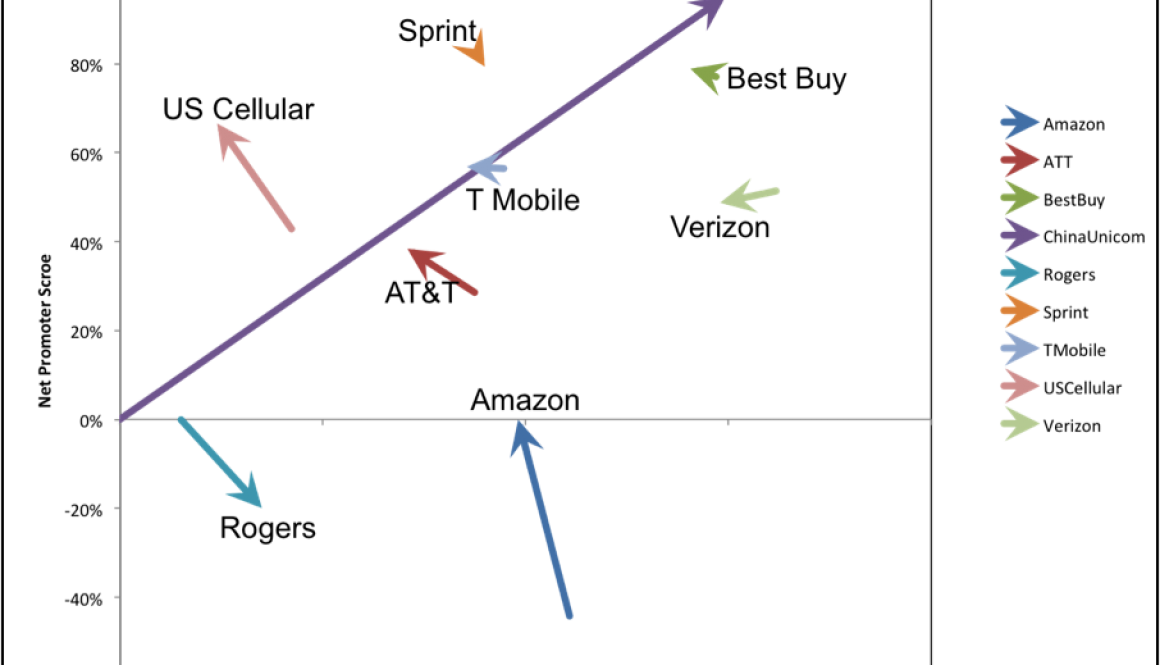
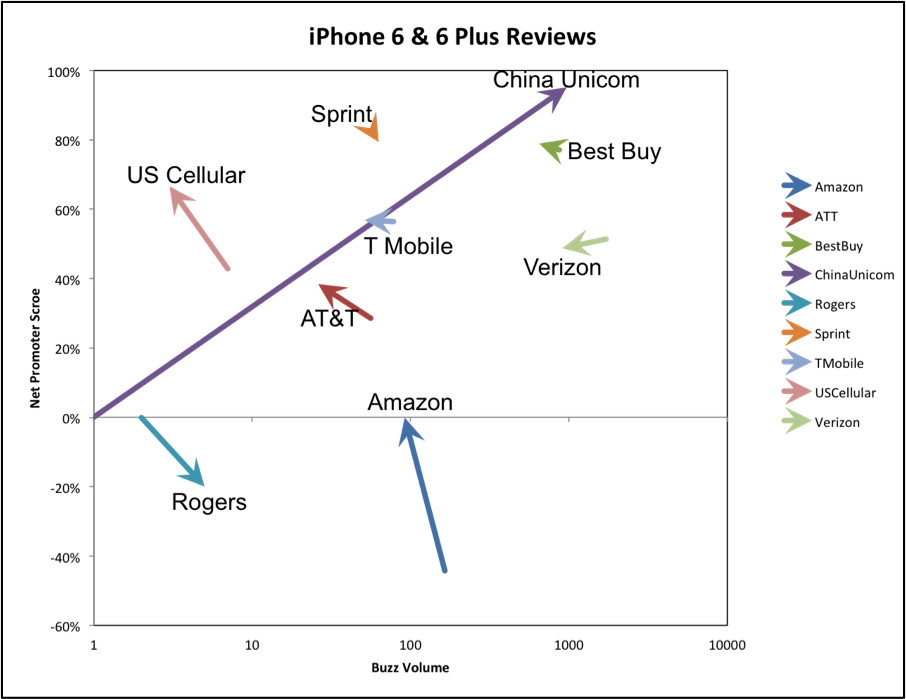
Consumers who did business through China Unicom and Sprint have been the most satisfied so far. New iPhone models did not go on sale in the Chinese market until early October, so that explains China Unicom’s abrupt increase in review volume. Even so, their high Net Promoter Score proves that Chinese consumers are happy with their new iPhones. Sprint, Best Buy, and US Cellular are the most delightful iPhone 6 and 6 Plus retailers in the US, all boasting an NPS over 60 percent. Verizon saw the most consumer reviews for the new iPhone models, most likely as a result of aggressive upgrade promotions, but that volume is shrinking as we approach the end of October.
At this point, it is safe to suggest that people should buy their new iPhones from Best Buy or Sprint. Although Sprint has a higher NPS at the moment, that score is dropping slowly as more reviews are written. Best Buy’s review volume is slowly shrinking, but there has been no dramatic drop-off, and their NPS continues to rise as large amounts of customers report satisfaction. Consumers are happy with these retailers for different reasons. Sprint’s vast improvement over their 3G with new LTE is netting praise. One Sprint customer said that “the change is amazing,” since they were used to the “super slow 3g network,” but now “the LTE is faster.” This was not an isolated incident either, as several other customers wrote about the “great mobile service on the iPhone 6 with Sprint Constant LTE.” At Best Buy, consumers were pleased with the speed and quality of service. Reporting that they had “a hassle free experience at Best Buy,” and even that they were “out in 20 minutes with $25 dollars more than Verizon offered” for their trade in. The consumers have spoken, and they are having the best iPhone 6 and 6 Plus experiences with Sprint and Best Buy.
If you would like to know more about iPhone 6 and 6 Plus performance, or any other smartphone, wearable, consumer technology, appliance, or home automation products, for that matter, please contact Argus Insights. You can sign up for our free weekly newsletter to keep up with consumer trends, or visit our website to subscribe to our data, schedule personalized consultation, or order custom reports.